
Important: Vantelyx Labs presents product information strictly for legitimate research purposes only. Enquiries regarding human consumption are strictly prohibited.
Actin & cell migration
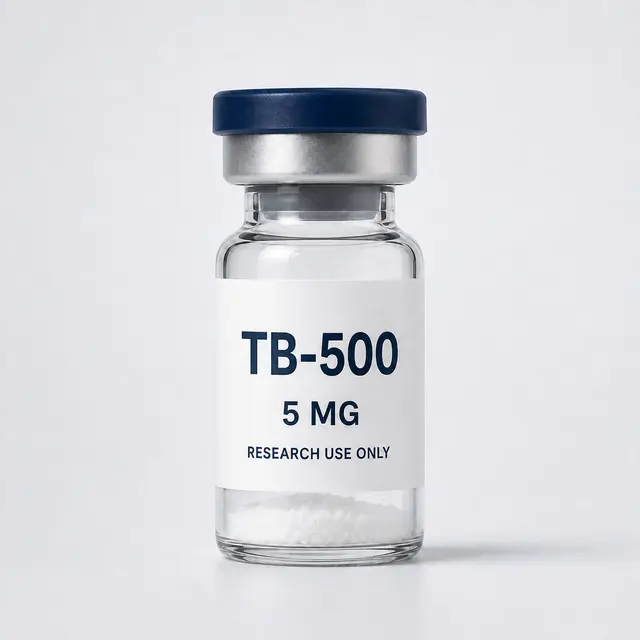
TB-500
5 mg
A thymosin-beta-4-related synthetic peptide used in controlled laboratory work on actin binding, cytoskeletal organisation, cell migration and repair-associated signalling.
Research information only
For product specifications, COA documentation or further factual information, contact Vantelyx Labs.
Research-use information only. Not presented for human or veterinary administration.
QUALITY ASSURANCE
Third-party COA testing
Third Party COA tested. Please contact us for reports.
ABOUT THE COMPOUND
Description & research context
TB-500 is commonly used as a laboratory reference name for a synthetic peptide derived from an active region of thymosin beta-4. Research involving thymosin-beta-4-related peptides focuses on their interaction with actin and the resulting effects on cytoskeletal organisation.
In biochemical and cellular models, these peptides are examined for G-actin interaction, actin polymerisation, cell migration and remodelling-associated signalling. Experimental responses vary with cell type, assay conditions, concentration and exposure time.
APPLICATIONS IN RESEARCH
Common experimental themes
- Actin dynamics and cytoskeletal regulation
- Cell migration and cellular organisation in vitro
- Experimental tissue-structure and repair-signalling models
- Reference work in thymosin-beta-4-related peptide research
LABORATORY HANDLING
Handling & stability
- Handle lyophilised material under dry conditions.
- Use an assay-appropriate sterile or buffered aqueous solution for laboratory preparation.
- Avoid vigorous agitation during dissolution.
- Aliquot prepared solutions when appropriate for the study design.
- Minimise repeated freeze-thaw cycles and protect from prolonged light exposure.
RESEARCH NOTES
Interpretation & precautions
- Buffer composition, pH and ionic strength can influence peptide stability.
- Experimental outcomes depend on model system and assay conditions.
- Use appropriate controls and validated analytical methods where required.
- For laboratory research use only.
REFERENCE READING