
Important: Vantelyx Labs presents product information strictly for legitimate research purposes only. Enquiries regarding human consumption are strictly prohibited.
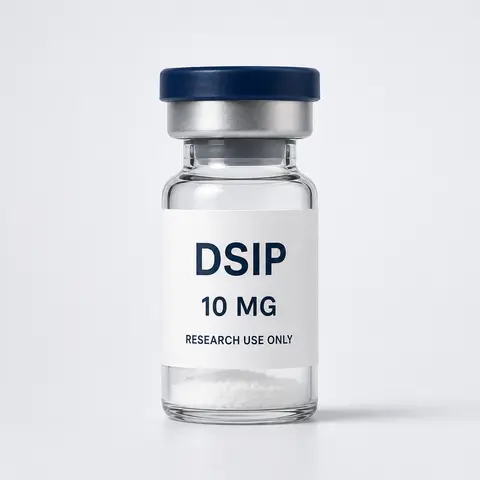
Neuropeptide signalling
DSIP
10 mg
A naturally occurring nine-amino-acid peptide used in experimental work on neuropeptide signalling, neuroendocrine pathways and stress-associated molecular responses.
Research information only
For product specifications, COA documentation or further factual information, contact Vantelyx Labs.
Research-use information only. Not presented for human or veterinary administration.
QUALITY ASSURANCE
Third-party COA testing
Third Party COA tested. Please contact us for reports.
ABOUT THE COMPOUND
Description & research context
Delta Sleep-Inducing Peptide (DSIP) is a short endogenous peptide first identified in neurochemical research associated with sleep-related brain activity. It has been detected in central nervous system tissues and other biological compartments in experimental models, while its precise biosynthetic origin and precursor remain incompletely characterised.
In laboratory research, DSIP is used as a molecular probe for neuropeptide and neuroendocrine signalling. Published work has explored stress-associated pathways, peptide-receptor interactions and signalling systems including NMDA- and MAPK-associated mechanisms. Results vary considerably with concentration, model system and experimental design.
APPLICATIONS IN RESEARCH
Common experimental themes
- Neuropeptide-mediated signalling in central nervous system models
- Neuroendocrine and stress-response pathway research
- Peptide stability, degradation and carrier-protein interaction studies
- Reference work involving short endogenous neuropeptides
LABORATORY HANDLING
Handling & stability
- Handle lyophilised material under dry laboratory conditions.
- Use an assay-appropriate aqueous or buffered vehicle according to the experimental protocol.
- Avoid vigorous agitation during dissolution.
- Prepare aliquots where appropriate and minimise repeated freeze-thaw cycles.
- Because DSIP can show limited stability in some in-vitro systems, working solutions should be prepared in line with the study protocol.
RESEARCH NOTES
Interpretation & precautions
- Experimental behaviour is highly dependent on concentration, exposure time and model system.
- Buffer composition, pH and enzymatic activity can affect peptide stability.
- Published findings are heterogeneous across different experimental models.
- For laboratory research use only.
REFERENCE READING